
Precision forestry
Integrated pest management
What is Integrated Pest Management
All RGE’s business groups involved in forestry and agriculture use what’s known as an integrated pest management system to deal with pests and disease. Healthy, resilient forests are essential to both environmental sustainability and long-term productivity. However, forest plantations face constant threats from pests and diseases, which can significantly reduce growth and yield.
Integrated pest management uses a variety of methods and technologies to:
- Prevent disease and infestations before they happen
- Breed trees that are more resistant to infection
- Deal with pests and disease as quickly, efficiently and sustainably as possible
- Increase productivity of plantations
- Reduce or eliminate chemical pesticides by using natural pest control methods where possible

Asian Agri’s Integrated Pest Management programme
The Integrated Pest Management programme plays a key role as Asian Agri works towards its Asian Agri 2030 commitment to reduce pesticide usage by 50 per cent. Asian Agri uses natural methods to reduce the use of pesticides and other chemicals through its Integrated Pest Management programme, including:
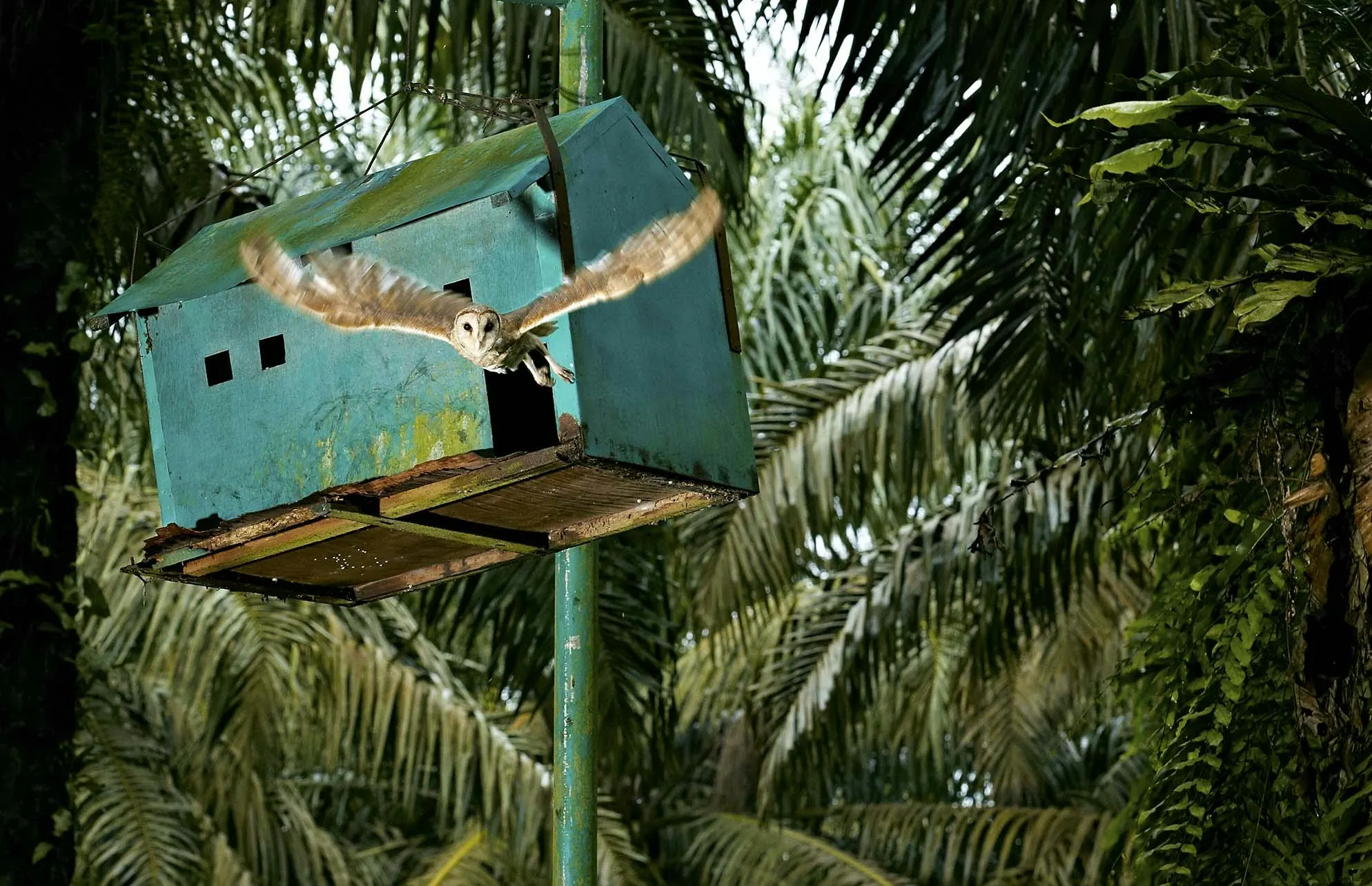
- Natural pest control: Asian Agri uses barn owls to hunt the rats that would otherwise eat the palm oil fruits. Owl houses are constructed at regular intervals in our plantations, with each owl eating as many as five rats per night.
In 2024 Asian Agri launched its own aviary and breeding programme to help sustain barn owl numbers, including a mouse-breeding section to ensure a plentiful food supply. - Breeding of predators: The company also breeds an insect called sycanus, which is a natural predator of the caterpillars that attack young oil palms. In order to support the insects we plant turnera subulata flowers across our plantations: these colourful flowers provide a natural home for sycanus, helping them to thrive.
- Disease-resistant seeds: Asian Agri has custom developed its own seeds, known as Topaz, at its Oil Palm Research Station in Indonesia. In addition to other benefits such as higher yields they are more resistant to ganoderma disease, a fungus that can infect plantations. They are used in Asian Agri’s own plantations, by smallholder farmers who benefit from the higher income they bring, and by customers in oil palm growing areas around the world.

Bracell’s Integrated Pest and Disease Management
Bracell’s Integrated Pest and Disease Management helps ensure healthy, productive and sustainable plantations through a variety of methods:
- Field and nursery monitoring: Ground teams monitor plantations to assess the impact of significant pests and diseases. In the nurseries careful monitoring is used to determine when to intervene and strategies for controlling any problems with disease and pests that are identified. Bracell also uses remote sensing tools such as drones and satellites to assist in landscape analysis, enabling comprehensive assessments of plantations.
- New technologies: Bracell uses a wide range of technologies to help prevent pests and disease. Scientists develop bacteriophages – viruses that only infect bacteria – to combat bacterial wilt by attacking the bacteria that infect the plants. Portable Near-InfraRed (NIR) scanners are used to analyse mother plants in the nursery to ensure they are healthy and to identify any problems as soon as possible. And our researchers continue to explore alternative methods for controlling leaf-cutting ants, aiming for greater effectiveness and reduced chemical use.
- Biological control: A team of scientists mass produce natural enemies of common pests, providing a method to control their numbers without the need for pesticides and other chemicals. Bracell also uses friendly fungi known as endophytes to help combat fungal disease in our nurseries.
- Pest and disease screening: All genetic materials undergo rigorous screening before they are used in our plantations. We also use a process known as disease phenotyping to understand more about pathogens, helping us devise better strategies to combat them. And we use field screenings to assess the resistance of clones under natural conditions, rather than just in the lab. All these methods help us better understand the characteristics of disease and predict how our trees will cope.

APRIL’s Integrated Pest Management programme
Before trees are planted, APRIL evaluates potential planting sites for soil nutrients, pH levels, and weed competition to minimise the risk of pest and disease outbreaks.
The first line of defence is to use natural controls wherever possible, such as by breeding predators that eat the insects that infest young eucalyptus plantations. APRIL recently completed construction of a 300m2 facility to mass-produce these friendly insects, helping reduce the need for chemical pesticides.
Careful monitoring allows APRIL to spot problems with pests and disease early and to begin treatment as soon as possible. Chemicals are now only used when and where necessary: for example, in emergencies or when natural controls are ineffective.
APRIL also uses drones and other technologies to improve precision and efficiency, minimise the number of applications, and reduce the overall volume of chemicals used.
APRIL’s research into efficient pesticide usage allowed the use of only green-and-yellow toxicity pesticides at our sites in 2023. The goal is to use only green-label products in future.
Why RGE uses Integrated Pest Management
Plantations are naturally subject to problems from pests and disease, which can lower productivity and even kill plants outright. By integrating pest management into all aspects of our plantation management we can ensure that pests and diseases are tackled effectively and sustainably.
Investing in research and development means that we can increase the usage of natural pest and disease control methods, ensuring good results while reducing environmental impact.
The result is that integrated pest management:

Increases productivity of plantations

Reduces chemical pesticide usage