


Precision forestry
Production-protection
What is APRIL’s production-protection model
APRIL Group uses a production-protection model which integrates both fibre plantations and natural forest restoration and conservation areas. This approach helps keep forests safe from external threats and encroachment, while also generating funds for further conservation work.
By balancing economic, social, and environmental considerations, the production-protection model has proven effective for conservation and restoration areas in Indonesia for more than a decade.
Under the production-protection model, plantations provide the funding as well as the resources such as fire suppression capabilities that are needed to protect conservation forest. In many cases the plantations also serve as a physical barrier to prevent encroachment of conservation areas.
As part of its APRIL2030 commitments, APRIL has pledged to spend US$1 per tonne of plantation fibre delivered to the wood yard annually to support and sustainably fund these conservation and restoration areas. This unique internal levy meant we were able to allocate US$14.8 million for conservation in 2024 alone, with a total of over US$75 million since 2020.
Through its 1-for-1 commitment, APRIL pledges to conserve one hectare of natural forest for every hectare of plantation.
APRIL’s Restorasi Ekosistem Riau (RER) project
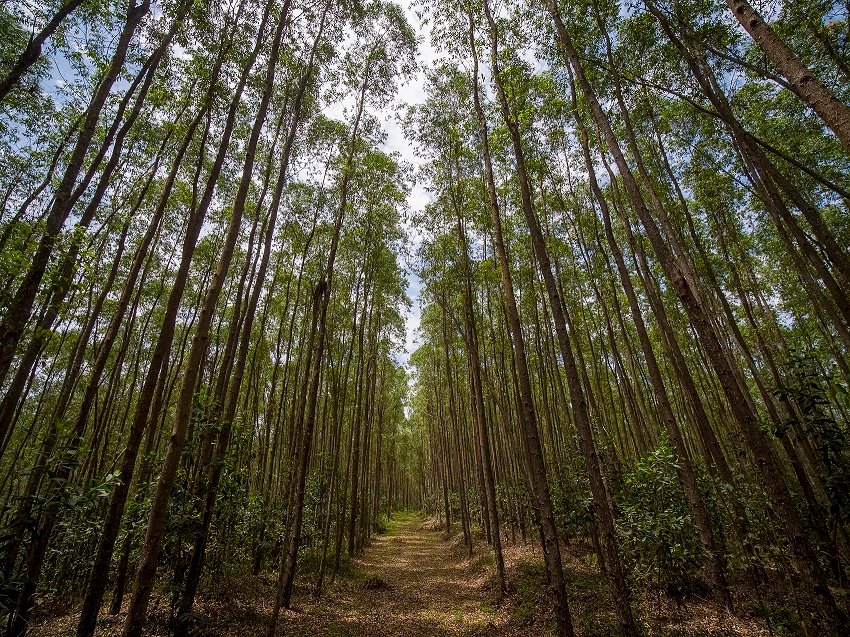
In its flagship RER restoration project APRIL has developed a ‘plantation ring’ to form a physical barrier protecting natural peat forests from encroachment and degradation. Acacia plantations were established as part of the licenced development of sustainable fibre plantations, largely over the most degraded forests on the periphery of both the Kampar Peninsula and Padang Island. These plantations create a buffer zone that conserves the restoration and conservation area of ecologically important raised peat domes.
The plantation ring does more than protect forests and their biodiversity – it also contributes to:
- Water management
- Fire prevention and control
- Controlling peat subsidence and carbon emissions
Active management of both the plantations and restoration forests ensures rapid fire response capabilities are always available. Additionally, APRIL works with nearby communities on fire prevention programmes.
Production-protection model
Four key principles of APRIL’s production-protection model:
01.
Maintain ecosystem integrity
Strengthen ecosystem integrity and enhance ecosystem services in degraded landscapes through well-designed plantation forests.
02.
Protect and enhance High Conservation Value (HCV) areas
Protect highly biodiverse areas, including riparian zones. Improve the natural habitats of rare, threatened and endangered species.
03.
Stakeholder involvement
Build and maintain positive relationships while collaborating with stakeholders, including local communities.
04.
Economic growth and employment
Create jobs and contribute to the national economy and the prosperity of local communities.
What is a landscape approach
APRIL takes what’s known as a landscape approach, which means looking at the larger area and not just individual parcels of land. That involves taking into consideration not just factors like productivity, but natural capital too, such as wildlife, soil and ecosystem services.
Under APRIL’s Sustainable Forest Management Policy (SFMP) 2.0, the company enforces a complete moratorium on deforestation. All forest areas are independently assessed to determine their High Conservation Value (HCV) or High Carbon Stock (HCS).
HCV areas may be identified due to:
- The presence of rare or threatened species
- Ecosystem services (eg clean water)
- Cultural or historical importance
HCS assessments focus on the forest’s carbon storage potential based on its vegetative cover.
Areas with high HCV or HCS values can be set aside for conservation, while degraded land with lower values is more suitable for plantations.
Academic studies on production-protection
APRIL’s production-protection model was the subject of a case study by the Lee Kuan Yew School of Public Policy (LKYSPP), which tells how APRIL “took steps to balance the economic and environmental concerns of paper production while taking into account multiple stakeholders, including the Indonesian government, local communities and consumers”.
LKYSPP Research Associate and case study author Tara Thean conducted a series of on-site visits in Kerinci, as well as interviews with the company’s senior management including APRIL Chairman Bey Soo Khiang.
“This case study tells the story of one company’s attempt to balance the demands of growth and sustainability in Sumatra, Indonesia amid government regulation, public scrutiny and socioeconomic pressures,” said Thean.